

How Do CD Interest Rates Work? Understanding APY and Compounding

What if your savings could earn more without taking on more risk? That’s the promise of a Certificate of Deposit (CD): a way to grow your money at a steady, predictable rate.
But how do CD interest rates actually work, and what’s the difference between the rate you see advertised and the APY? In this guide, we’ll break down how CD rates and APY work, how compounding affects your earnings, and how to compare rates across terms so you can make the most of your savings.
What Is a Certificate of Deposit?
A Certificate of Deposit, or CD, is a type of savings account offered by banks and credit unions. When you open a CD, you deposit a specific amount of money and agree to leave it in the account for a set period. In return, the financial institution pays you a stated rate on your savings.
Unlike a traditional savings account, a CD is designed for money you don’t expect to need immediately, since withdrawing funds before the term ends may result in a penalty.
Federally insured credit unions provide share insurance through the National Credit Union Administration (NCUA). Eligible accounts at federally insured credit unions are generally insured up to $250,000, subject to applicable coverage limits.
For additional protection, JDCU also provides excess share insurance through MSIC, offering coverage beyond the standard federal insurance limits for qualifying deposits.
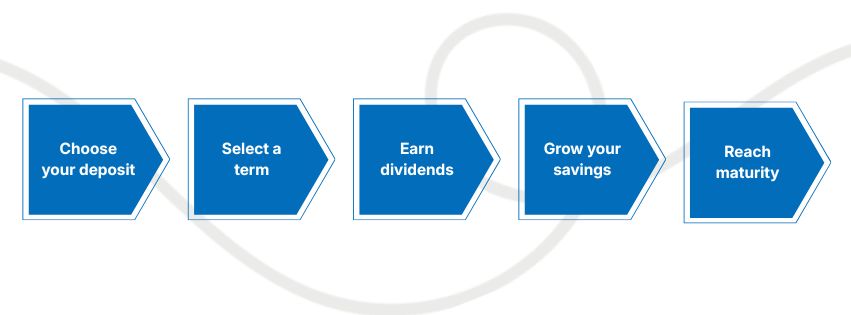
At a high level, opening a CD follows the same basic path regardless of term or rate: you make your deposit, choose your term, earn dividends as your funds sit untouched, let those dividends compound, and access your funds once the CD reaches maturity. Learn more about the basics of how a CD works here.
How Do CD Interest Rates Work?
When you open a CD, the financial institution agrees to pay you a set rate in exchange for keeping your funds deposited for the term you choose. That rate is generally fixed for the life of the term, so it won’t change even if broader rates shift after you open the account.
CD rates typically vary based on a few factors:
- Term length: Longer terms often come with higher rates, though this isn’t always the case, as special offers can sometimes make shorter terms just as competitive.
- The broader rate environment: Rates on new CDs tend to move with the overall interest rate climate (more on this below).
Understanding APY and Compounding
When comparing CDs, you’ll typically see both an interest rate and an annual percentage yield (APY), and understanding the difference between the two can help you make a more informed decision.
The interest rate is the stated rate paid on your deposit. The APY, on the other hand, reflects what you can actually earn over a year once compounding is factored in, which makes it the more useful number when comparing deposit products against one another.
Compounding is what allows your savings to grow faster over time. Instead of only earning dividends on your original deposit, you also earn dividends on the dividends you’ve already accumulated. The more frequently your CD compounds (daily, monthly, or otherwise), the more your balance can benefit from this snowball effect.
What That Looks Like In Practice
Say you deposit $5,000 into a 12-month CD with a 4.00% interest rate, compounded monthly. Because of monthly compounding, your effective APY is actually 4.07%. By the end of the term, you’d earn roughly $204 in dividends, bringing your total balance to about $5,204.
Now compare that to a CD with the same 4.00% interest rate, but compounded only annually instead of monthly. That CD has a 4.00% APY and would earn exactly $200 over those same 12 months—a $4 difference. It’s a small gap on $5,000 over one year, but it grows more noticeable with larger deposits, longer terms, or bigger rate differences. It’s exactly why two CDs advertising the same initial interest rate can leave you with different amounts in your pocket.
| Calculation Type | Stated Interest Rate | Compounding Frequency | Effective APY | Total 12-Month Return ($5,000 Deposit) |
| Simple / Annual Rate | 4.00% | Annually | 4.00% | $200.00 |
| Compounded Rate | 4.00% | Monthly | 4.07% | ~$203.70 |
This is why APY, not the interest rate alone, is the number to focus on when comparing your options. Because APY already accounts for compounding, it gives you a clear, apples-to-apples way to compare CDs across different terms and institutions.
CD Rates and the Interest Rate Environment
CD rates don’t exist in a vacuum. They’re shaped by the broader interest rate environment, and understanding that connection can help explain why rates look the way they do at any given moment.
At the center of this is the federal funds rate, set by the Federal Reserve. When the Fed raises this rate, financial institutions often respond by offering higher rates on new deposit products, CDs included. When the Fed lowers it, new CD rates tend to follow suit and decline.
This is part of why locking in a CD rate can work in your favor. Once you open a CD, your rate is generally fixed for the full term, meaning it won’t change even if the broader rate environment shifts afterward. If rates are on a downward trend, opening a CD now can help you hold onto a higher rate for the length of your term. If rates are expected to rise, some savers prefer shorter terms so they can reopen a new CD at a better rate once it matures.
There’s no way to perfectly time the market, but keeping an eye on the broader rate environment, alongside your own savings timeline, can help you decide not just which term is right for you, but when it makes sense to open a CD in the first place.
Ready to see the numbers for yourself? Compare current rates and calculate your potential earnings below.
Check Rates & Calculate Potential Earnings
How Term Length Affects Your Rate
Term length is one of the biggest levers you have when it comes to the rate you’ll earn. Generally, the longer you’re willing to leave your funds untouched, the higher the rate a financial institution is willing to offer.
That said, choosing a term isn’t just about chasing the highest rate. Consider:
- How soon you’ll need the money: A higher rate isn’t worth much if you end up paying an early withdrawal penalty to access it.
- The rate and APY for each term: Compare what each term could realistically earn you.
- Your need for flexibility: Shorter terms free up your funds sooner, even if it means a lower rate.
What Happens When a CD Matures?
The maturity date is when your CD’s term ends, and you’ll generally have options for what to do with your funds, including withdrawing them, moving them to another account, or renewing for another term.
Early Withdrawal Penalties and Your Rate
An early withdrawal penalty doesn’t just cost you a fee; it effectively lowers the rate you actually earn on your CD. If you withdraw funds before maturity, the penalty (often calculated as a certain number of months’ worth of dividends) eats into the earnings your rate was meant to provide.
This is why it’s worth choosing a term you’re confident you can commit to. A CD may be better suited for money you don’t expect to need in the near future, so you can earn the full rate you signed up for.
Start Growing Your Savings with JDCU
Now that you know how CD rates and APY actually work, you can see how choosing the right term and understanding compounding can make a real difference in what you earn.
At Jeanne D’Arc Credit Union, you can open a Certificate of Deposit with just $250, choose a term anywhere from 6 to 60 months, and watch your dividends compound each month, all with no monthly fees. Rates climb the longer you save, and select terms even come with a one-time bump-up option if market rates rise during your term.
Whether you’re chasing the highest rate or the right balance of rate and flexibility, there’s a CD term to match your goals.